Top Signs You Need Garage Door Service – Don’t Ignore These
A garage door that opens every time is not a healthy door. It’s a door that hasn’t failed yet. The spring that’s about to snap, the cable that’s one cold morning from fraying, and the track that’s slowly pulling away from the wall don’t announce themselves until the door is stuck on your car. The warning signs exist, but they’re quiet: a hesitation, a grind, a gap you’ve stopped noticing. We’re going to point them out so you can act before a repair becomes a replacement.
Key Takeaways
- Run the lift test every few weeks: a healthy door lifts smoothly with one hand and stays put halfway up.
- Slow reversal is often an earlier signal than no reversal at all, and it usually traces to force-limit drift.
- Grinding, popping and scraping each point to different components, and they don’t fix themselves.
- An uneven bottom seal can mean a misaligned track or a settling foundation. The door can tell you which.
- A door that works fine in summer but drags in January is telling you about spring tension, not old age.
1. The Door Feels Heavy or Uneven When You Lift It By Hand
This is the single best diagnostic you can do yourself, and almost nobody does it. Disconnect the opener using the manual release cord (usually the red handle) so the door moves free. Then lift the door by hand to about waist height and let go. A well-balanced door should rise with modest effort and hang there, give or take a few inches. If it slams down, feels heavy from the first foot of travel, or rises crookedly, something underneath is carrying more load than it should.
Almost always, that something is a spring. A two-spring setup where one has lost tension puts all the weight on the survivor, so the door will feel heavy and drift to one side. Extension springs on Raynor and older Craftsman doors show the same symptom when one has stretched past its workload. In our experience across Old Brooklyn, the lift test catches a failing spring weeks before it actually snaps, which is the moment you want to know.
One caveat before you try it: never reach up to inspect, adjust or remove a torsion spring or the cable drums themselves. Those are high-tension parts under enormous force, and a single wrong move can cause serious injury. Feel the door by the handle, look at the springs from a distance, and leave the actual spring work to a technician.
2. The Reversal Response Is Slowing Down
Everyone knows a door should reverse when it meets an obstruction. What most homeowners miss is that a slow or sluggish reversal is an early warning that comes before the door stops responding entirely. If you hold a block of wood under the door and it pushes down on it for a beat before backing off, the opener’s force limit has started to drift. That drift is normal wear on the mechanism, but if it’s left alone it is the first step toward opener burnout, and it can send the door down with far too much pressure on whatever happens to be underneath.
The fix depends on the unit. On modern LiftMaster and Chamberlain openers, the force limit and travel are set through a calibration routine, and a trained technician can dial them back in without replacing anything. A Craftsman or Genie unit of an older vintage may need a mechanical adjustment to the limit screw or a fresh set of drive gears. Part of why we work on those systems specifically is that the adjustment points live in different places on each one, and guessing wastes everyone’s time.
3. The Sound Is Wrong, Not Just Loud
Garage doors are not silent machines, and a door that rumbles a bit as it travels is usually fine. What matters is the type of sound. Grinding, popping and scraping each point to a different component, and a technician can tell a lot just from listening.
- A grinding noise that runs near the opener housing often points to a worn gear or a failing drive in the motor unit. On an opener, that’s usually a repair rather than a sign to tear the whole door out.
- A popping or snapping sound during travel usually means a bearing plate or hinge has loosened under the load of a heavy door. Left alone, it will start tearing at the fasteners.
- A metal-on-metal scrape travelling with the door suggests a roller or a section running against the track. That’s track alignment, and it gets worse the longer it scrapes.
- A loud bang with no obvious cause, after which the door won’t move, is a spring that has let go. This is a call situation, not a wait-and-see one.
When a sound appears in Old Brooklyn, we’d rather you had a technician look at it than wait for the component to fail outright. A quiet adjustment today is cheaper than a snapped spring tomorrow.
4. The Bottom Seal Doesn’t Sit Evenly
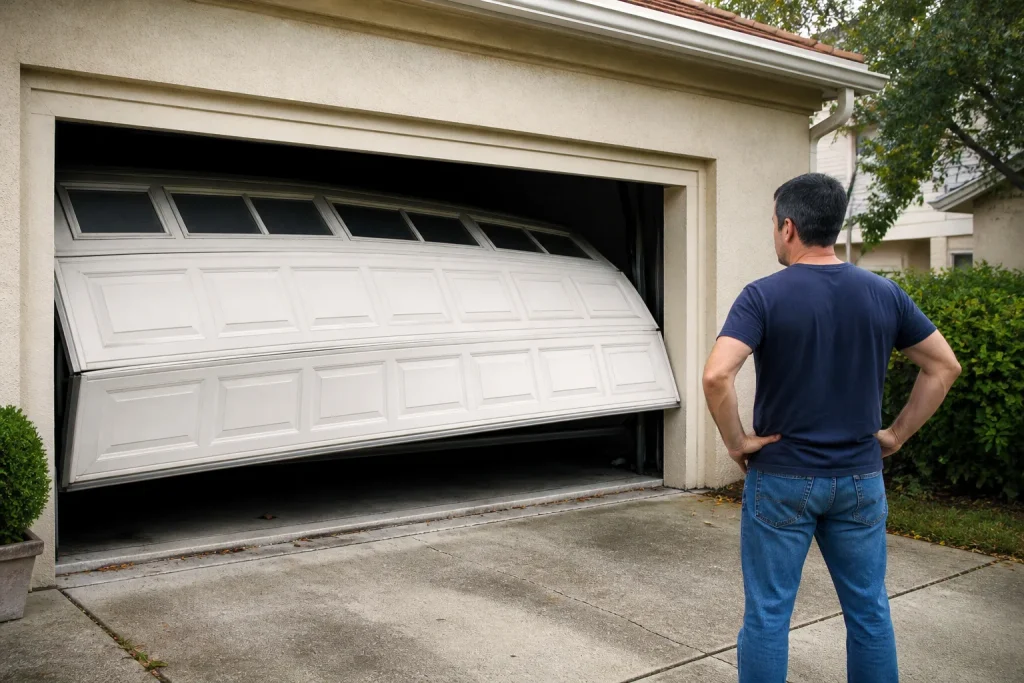
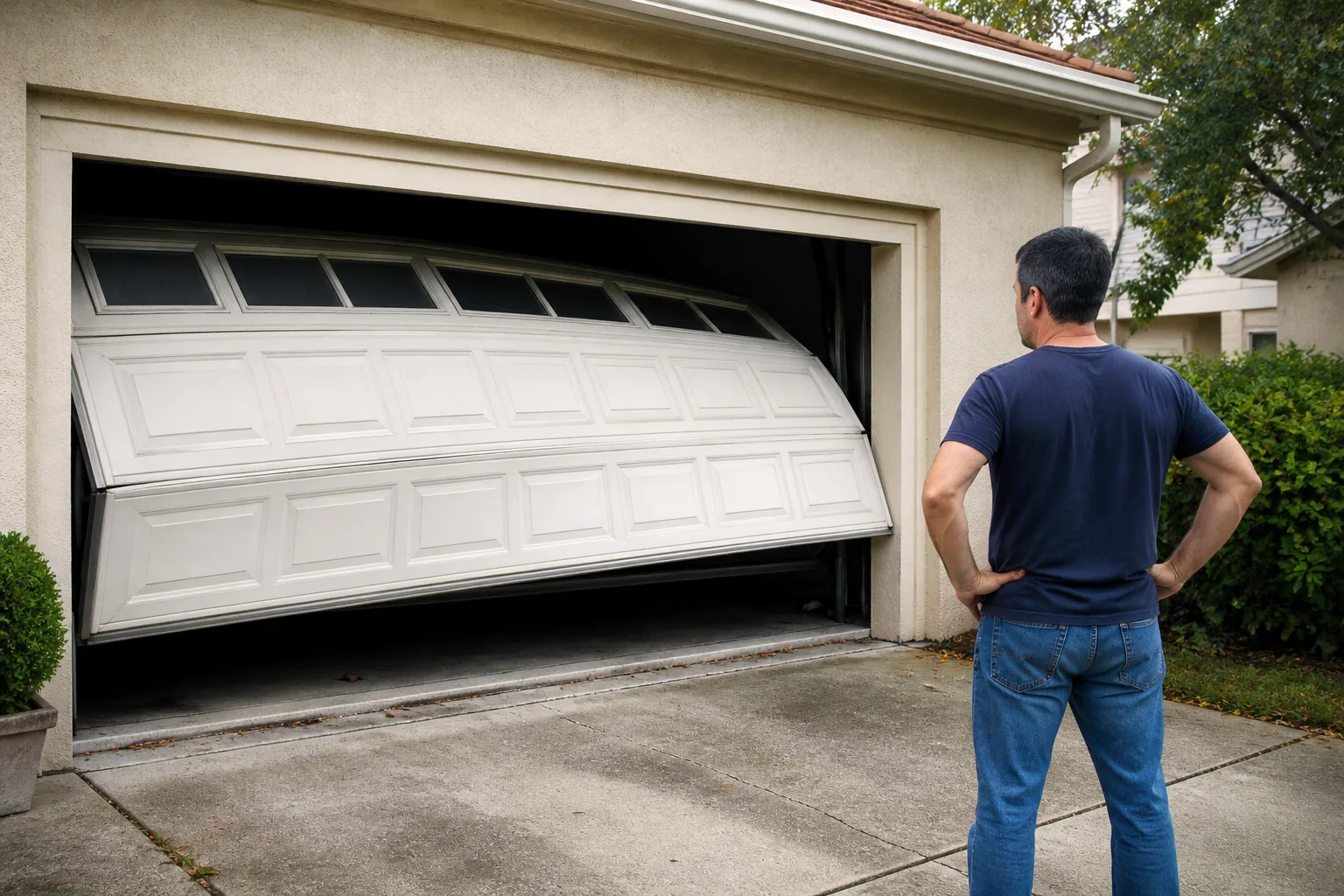
A door that leaves a visible gap at one corner of the bottom seal is telling you one of two things, and the door can help you tell which. First, look at where the gap is and whether the door itself is square in the opening. If the door is visibly skewed to one side, a track has shifted or is out of alignment, and realigning it is the fix. If the door looks level but the seal still doesn’t meet the ground evenly, the floor itself may have settled. Old Brooklyn homes sit on aging foundations, and floors do move over time. In that case a new bottom seal with the right profile can close the gap without touching the door’s structure at all.
A gap at the bottom is worth fixing on its own merits: it stops drafts, keeps heat and pests out, and keeps the house more secure. Telling the two causes apart means you fix the actual problem rather than throwing a seal at a track that’s out of line. If you can’t tell by looking, we can check alignment and seal in one visit.
5. Summer Works, January Doesn’t
If your door opens smoothly on a warm day and drags or feels stiff on a cold morning, the door’s age isn’t the culprit. It’s spring tension calibration. Metal contracts as it cools, grease thickens, and the door’s roller-to-track fit tightens. A door that was only marginally balanced to begin with becomes noticeably heavy once the temperature drops. In Old Brooklyn’s colder months, that margin is exactly what separates a working door from one that won’t come up.
The door isn’t broken in that scenario, it’s misbalanced. A technician can re-tension or replace a spring to bring the door back into its proper range so it opens reliably in cold weather as well as warm. Ignoring a winter-only symptom is how a door goes from “always opens” to “opened every time until it didn’t.”
When to Call a Pro
You can run the lift test, listen carefully and check your bottom seal without touching anything dangerous. Once you find the problem, some fixes are genuinely not a homeowner job. Spring work, cable work and anything that has you reaching up to the torsion tube are best left to a technician with the right tools and training, and an opener that’s started slipping needs calibration you can’t eyeball. If you’d rather not climb a ladder and diagnose, just call us and we’ll sort it out on the spot. If the door is stuck open or shut and the house is exposed, our emergency service exists precisely for that call. And if an old door has gone too far, the same visit can spell out repair versus replacement, since we handle both from a single call rather than sending you to a second company.
Related services in Old Brooklyn: Our garage door repair team handles failing springs, tracks and cables. For control issues, our garage door opener repair covers LiftMaster, Chamberlain, Genie and Craftsman units. If the door is genuinely finished, our garage door installation service takes it from broken to brand new, and our spring specialists are who we call for torsion and extension work.
The Bottom Line
The list of signs is short: a heavy or uneven lift, a sluggish reversal, a grinding or popping sound, an uneven bottom seal, and trouble that only shows up when it’s cold. None of these are emergencies yet. That’s the point. Catching them now means a repair, not an unexpected morning stuck in the driveway, and one call covers the whole range, from Garage Door Repair Old Brooklyn diagnosis through springs, openers and a new door if it comes to that. Our technicians have up to 12 years of experience, and we work on eight of the industry’s dominant brands, so there’s no misdiagnosing your system. If you’re in Old Brooklyn and need help, Garage Door Repair Old Brooklyn offers free estimates and a written price before any work starts – call (888) 965-4156. Estimates are free, and same-day service is available for urgent problems.
Frequently Asked Questions
The earliest reliable sign is a door that feels heavy or uneven when lifted by hand, followed by a slow or sluggish reversal and a grinding or popping sound during travel. Catch any one of those and a service call is worth it before the door fails.
No. Torsion and extension springs are under high tension, and a mistake can cause serious injury. Feel the door by hand to check balance, look from a distance, and leave the spring and cable work to a technician. We handle spring repair as a specialty for exactly that reason.
Cold weather tightens the door’s roller-to-track fit and thickens the grease, so a door that was only marginally balanced becomes heavy. It’s a spring tension calibration issue, not age, and re-tensioning solves it.
Usually not. Grinding that runs near the opener housing typically points to a worn gear or drive, which is an opener repair rather than a new door. Grinding that follows the door’s travel points to a roller or track, also repairable. Have a technician identify the source first.
Written by the team at Garage Door Repair Old Brooklyn.
Need Garage Door Help?
Call Garage Door Repair Old Brooklyn - the local pro we connect you with is licensed and insured, here with fast after-hours help in Old Brooklyn.
(888) 965-4156