Garage Door Repair: Repair or Replace? How Old Brooklyn Homeowners Decide
Most homeowners reach for the age of the door first. It’s the easy number to grab. But age tells you almost nothing about whether a door is worth saving. A 20-year-old door with one snapped spring is usually a modest repair. A 7-year-old door with warped panels, a worn roller system, and an opener straining against bent tracks is a replacement waiting to happen. The variable that actually matters is component condition. Understand which parts wear out by design and which ones signal structural decline, and the decision gets much clearer. If you’d rather have someone diagnose it, call (888) 965-4156 and we’ll give you a straight answer.
Why Age Is the Wrong Number to Start With
A garage door is not one machine. It’s a set of parts with wildly different lifespans bolted together, and they fail independently. That’s the whole reason “how old is it?” misses the point. A door can be fifteen years old and structurally sound, or five years old and already on borrowed time because the panels were pushed out of plane and the tracks never recovered.
We sort the parts into three tiers, and this hierarchy drives every repair-or-replace call we make in Old Brooklyn:
- Consumables: springs, cables, rollers, hinges. These wear out on schedule. Replacing them is routine maintenance, not a verdict on the door.
- Structural: tracks, the bottom section, struts, the door’s overall alignment. When these are compromised, the door is telling you something bigger.
- Cosmetic: panel dents, paint, surface scratches. Ugly is not the same as failing.
When a consumable fails, you fix the consumable. When a structural component bends, warps, or pulls out of square, the question shifts toward replacement. That single rule of thumb is where a specialist and a generalist tend to part ways.
The Component Hierarchy: What Fails, and What That Failure Means
Every door in Old Brooklyn is doing the same thing: a heavy panel stack riding on tracks, held in check by a spring system that counterbalances the weight. The parts that carry load and the parts that just look nice behave very differently when they go.
Springs and cables are the wear items. They do the hard physical work of making a 150-pound door feel light, and they take the most abuse of any part on the system. A torsion or extension spring that snaps is a normal wear event, and it’s the job we handle most often. It’s also the most dangerous job on the whole door, and we’ll say that plainly: those springs are under high tension, and a spring or cable that lets go can cause serious injury. This is not a homeowner repair, and it’s not something to hand to a generalist who happens to own a wrench.
Track alignment is structural. If the tracks are bent or the door has jumped the track, the geometry of the whole assembly is off. Rollers will wear fast, the opener will labor, and panels can crack at the hinge points. Sometimes realigning and replacing the hardware fixes it. Sometimes the bend is a symptom of a warped bottom section, and then you’re looking at the frames of the door itself.
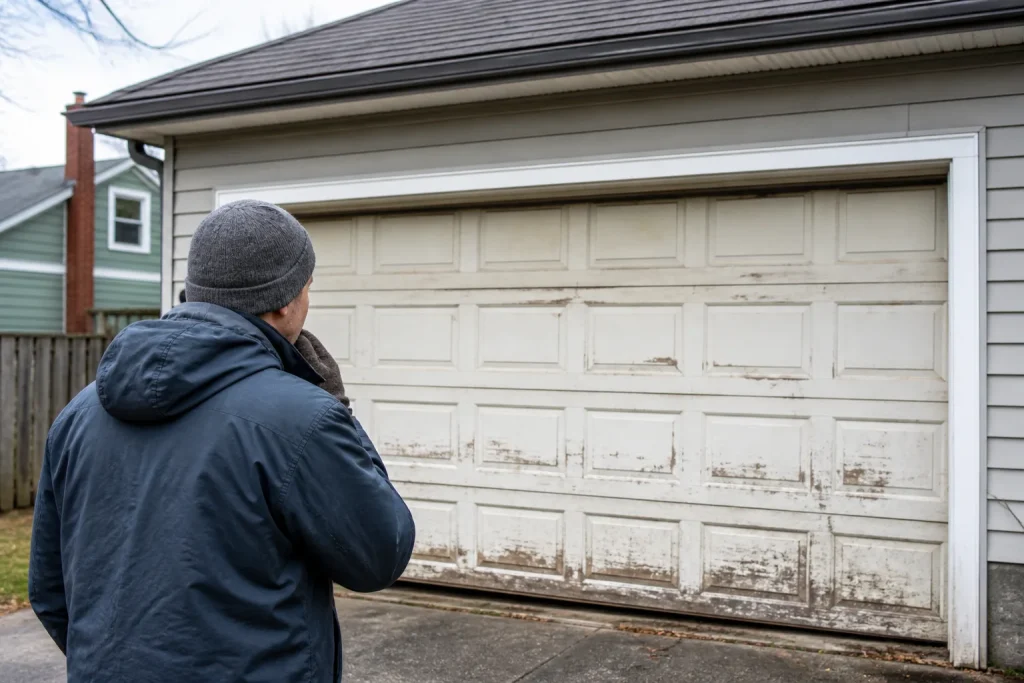
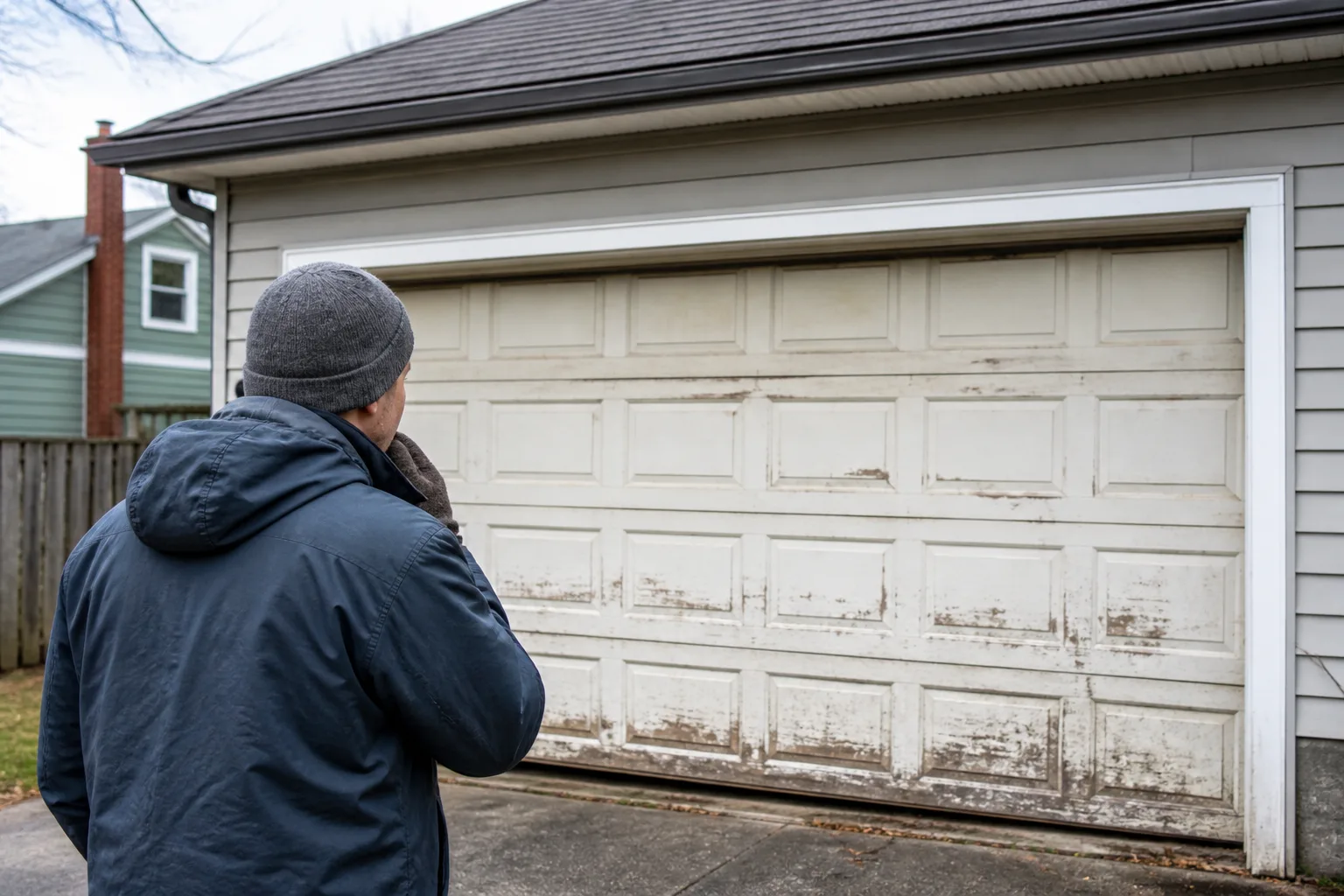
Panels are the cosmetic layer, except when they aren’t. A dented Clopay or Amarr panel that’s still square is a surface problem. The moment you check and the panel is bowed, the strut is loose, or the hinge area is cracked, cosmetic has quietly become structural. That’s the check most visual inspections skip.
How to Run the True Cost-of-Ownership Math
Repair-versus-replace usually gets settled with a pencil, not intuition. The mistake is comparing a repair quote today against a new door today and stopping there. The honest comparison is what the repair path costs you over the next handful of years, versus a replacement that resets the clock on the parts.
Use realistic part-life expectancies rather than manufacturer best-case numbers. Manufacturer figures often describe ideal conditions. Your door lives in real weather and gets used by real people. A practical way to structure it:
- List what’s still original on the door. Springs, rollers, cables, hinges. The older and more worn the whole set, the more likely a second repair follows the first.
- Estimate how many of those are near the end of their realistic life rather than failing out of the blue.
- Price the near-term repairs and add the likely follow-ups. If you’re replacing a spring now and can see rollers and cables that are clearly spent, put them in the same column. That’s the honest quote.
- Compare that multi-year repair total to a replacement, factoring in that installation resets the wear clock on the structural parts too.
Do this and one pattern shows up again and again: if the structural layer is sound, a door stays the cheaper choice for a long time, because you’re only ever paying for wear items. If the structural layer is compromised, repair can turn into a series of invoices that adds up faster than you’d expect. That’s when reallocating the money toward a replacement covers the whole system in one go.
Assessing Panel Damage: Check the Frame, Not Just the Dent
Here’s where a lot of money gets decided, and where a quick glance fails. A dent is the least informative thing about a damaged panel. The useful question is whether the panel is still square and whether the door’s structural integrity holds at the load-bearing points. So you check two places in particular:
- The hinges. If the panel has moved, the hinges tell you. Cracks, loose fasteners, or panels pulling away at the hinge line mean the damage has reached structure. A bowed Clopay or Amarr panel past that point tends to drag the whole assembly with it.
- The struts. A loose or bent strut means the door has lost some of its rigidity. Left alone, a weakened section flexes a little more every cycle, and the wear spreads.
A dented panel with tight hinges and a solid strut is worth saving. Cosmetic damage is real, but it’s not structural, and replacement there is a choice about appearance, not safety. A dented panel with a cracked hinge or a loose strut is a different conversation, and that’s the one where replacement often makes more sense, especially on an older door where the surrounding hardware is tired too. When you can’t tell the difference, that’s exactly the moment to have a professional look. You can read more about what we cover under garage door repair before you decide.
Why the Recommendation Changes Depending on Who You Ask
Owners get conflicting advice on this all the time, and often it comes down to what kind of business is giving it. A generalist handyman usually recommends replacement more readily than a specialist, for a simple reason: repairing a worn LiftMaster or Chamberlain system properly takes brand-specific knowledge and the right parts, and a generalist may not have either. Replacement looks like the safer route when the person diagnosing can’t confidently fix what’s in front of them.
The reverse also happens. A specialist recommends repair in cases where a generalist would have replaced the whole door, because the failure is clearly a wear item and the structural layer is fine. Springs, cables, and opener logic boards are the typical examples. When we work on a Chamberlain or Genie opener, for instance, a lot of “the door is done” diagnoses turn out to be a known opener or sensor fault, and the door itself was never the problem.
What should drive the recommendation is the component hierarchy, not the seller’s inventory. If a contractor can’t tell you which tier the failure is in, or can’t name the brand-specific fix, be cautious about taking a replacement recommendation at face value.
Old Brooklyn’s Climate and the Failures It Creates
Any repair-versus-replace call here has to account for the local weather, because it shapes which parts fail and how fast. Old Brooklyn sees real seasonal swings. Freeze-thaw cycles in winter and humidity through summer soak into wood panels, work the fasteners loose, and stress the metal through expansion and contraction. Those swings don’t create new failure modes, but they accelerate the ones everybody already deals with.
In practice, that means fewer “random” failures. Springs and cables wear a little faster than in a flat, dry climate. Wood and steel panels take on moisture and can warp or swell if the seals are tired. Hardware loosens over the winter and gets discovered in spring. Once your door has been through several of these cycles and the whole hardware set is showing the wear, the long-term repair math leans toward replacing more often than it would on a door that’s kept up. A single worn part in good surroundings is still a straightforward fix. It’s the compounding pattern that the climate makes more common.
If your door has been through a lot of these seasons and you want a clear-eyed read on which way the math points, garage door installation is worth a conversation as much as repair is.
When to Call a Pro
Some of this you can assess yourself. The dent, the age, the way the door sounds when it opens: those you can weigh. What we’d not have you tackle alone is anything in the high-tension layer. Springs, cables, and torsion assemblies under load are a genuine injury risk, and the tools and training to do the job safely are not the kind of thing you pick up from a video. A door that’s come off its tracks or one that won’t stay closed is a security and safety question, not a weekend project.
That’s where we come in. We handle spring repair as a specialty, not an afterthought, and we diagnose openers across the brands we work on constantly, including LiftMaster, Chamberlain, Genie, and Chamberlain’s myQ smart systems. If a door is stuck open or won’t close and needs urgent attention, we run same-day and emergency service. And because we cover repair and full installation, you won’t get pushed toward a second company when the diagnosis is replacement rather than repair.
Related services in Old Brooklyn: garage door opener repair when the door moves fine but the open/close side misbehaves, and our full Garage Door Repair Old Brooklyn service when you’d rather have a specialist make the call for you.
The Bottom Line
For most Old Brooklyn homeowners, the decision comes down to one question: is the failure a worn consumable or a structural problem? Springs and cables wear out; that’s a repair. Bent tracks, warped panels past the hinge line, and a frame that’s lost its integrity point toward replacement. Run the multi-year repair math against a replacement and let the totals decide. Our technicians have up to 12 years of experience reading exactly this, and we quote every job upfront, with the price agreed before any work begins.
If you’re in Old Brooklyn and need help, Garage Door Repair Old Brooklyn offers free estimates. Call (888) 965-4156 and we’ll tell you which way the math points on your door, repair or replace, with no pressure to do either until you’re ready.
Frequently Asked Questions
Look at what failed, not how old the door is. If it’s a spring, cable, or roller, repair it. If tracks are bent, panels have warped past the hinge line, or the frame is out of square, replacement is usually the better long-term call. Call (888) 965-4156 for a free estimate, and we’ll give you a specific read on your door.
No. A broken spring is a wear event, and replacing the spring is the normal fix. It only becomes a replacement question if the surrounding structural hardware is also compromised, which we check when we assess the door. Call (888) 965-4156 to get a proper diagnosis before you spend anything on a new door.
A dent alone usually isn’t structural. Check the hinges and the struts: cracks at the hinge line, loose fasteners, or a bowed panel past those points mean the damage has reached the frame. A panel that’s dented but still square with tight hinges is a cosmetic problem you can live with.
Basic things like cleaning tracks or tightening visible fasteners are manageable. Springs, cables, and anything under high tension are not. Those parts are under load that can cause serious injury if they slip, so they need a trained technician with the right tools. Call (888) 965-4156 and we’ll take the risky parts off your hands.
Written by the team at Garage Door Repair Old Brooklyn.
Need Garage Door Help?
Call Garage Door Repair Old Brooklyn - the local pro we connect you with is licensed and insured, here with fast after-hours help in Old Brooklyn.
(888) 965-4156